

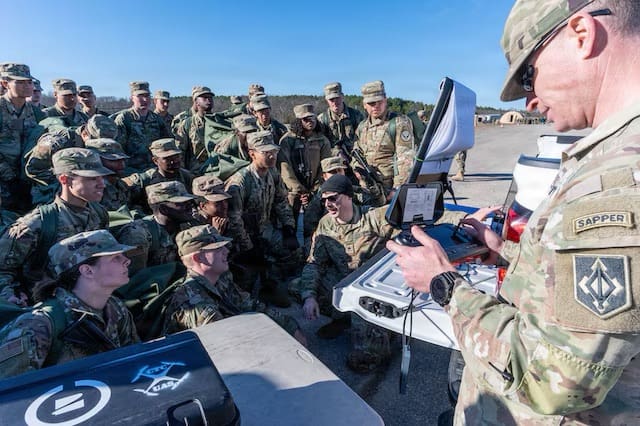
Why environmental resilience matters for military drones
Designing a combat-ready drone is not just about sensors and endurance — it’s about surviving months of salt spray and fine dust without failing mid-mission. Operators who attend drone training for military understand how equipment exposed on littoral and desert deployments must keep cameras, gimbals, and comms alive under corrosive conditions. Resilience affects mission success, logistics burden, and the lifecycle cost of a fleet.

Two schools of thought: ruggedization vs. maintainability
Across manufacturers you can spot two clear strategies. One camp pushes extreme ruggedization: higher IP ratings, corrosion-resistant coatings, sealed connectors, and aggressive conformal coating on electronics. The other prioritizes modularity and maintainability: slightly lower ingress protection but rapid field-replaceable sensor housings and standardized connectors so crews can swap damaged modules on-site.
What field tests and standards reveal
MIL-STD-810G salt fog and dust tests give a shared baseline that engineers and procurement officers trust. Real-world anchors matter: Gulf Coast deployments and naval exercises show how salt accelerates corrosion on unprotected joints within months. That pattern influenced many vendors to adopt enhanced sealing and better gasket materials after documented failures during coastal trials.
Comparing outcomes: where each approach wins
The ruggedization-first drones excel when maintenance access is limited and exposure is constant — for sea patrols or long-term base protection. The maintainability-first designs win when units operate with skilled crews nearby and rapid turnaround is possible, such as forward airstrips or convoy support. Both approaches trade cost, weight, and repair tempo differently.
Common engineering choices that change the game
Key technical moves tend to appear across top designs: improved IP rating for enclosures; sealed connectors to stop salt crystal intrusion; targeted conformal coating on PCBs; and corrosion-resistant coatings on frame and motor bell housings. Manufacturers also optimize air intake paths and dust filters for propulsion systems while ensuring cooling remains effective for payloads like EO/IR sensors.
Operational lessons and training implications
Field crews learn that preventive habits matter as much as hardware: routine salt-wash procedures, inspection of seals, and proper storage between sorties. FPV operators and pilots benefit from mission-focused exercises available in fpv drone training military programs that simulate degraded sensors and throttled comm links so teams practice contingency checks and module swaps.
Common mistakes to avoid
Buyers often overpay for the highest advertised ingress protection without assessing repair logistics — a heavy sealed unit that needs to return to the factory slows sortie rate. Conversely, choosing easily serviceable drones without robust seals leads to repeated failures in coastal or dusty theaters. Balance is the operative principle.
Practical checklist for procurement teams
Evaluate three concrete properties before buying: IP rating matched to the theater; modular repair time measured in minutes or hours; and documented field trials under MIL-STD-810G or equivalent protocols. Also confirm spare-part pipelines and crew training that cover rapid seal inspection and gasket replacement. These markers predict real readiness better than glossy specs alone.
Final advisory: three golden rules for selecting resilient systems
Rule 1 — Match design to mission environment: prioritize sealed, corrosion-resistant builds for extended littoral deployments; emphasize modularity where rapid repairs are realistic. Rule 2 — Insist on tested standards and field data: MIL-STD-810G results and documented coastal trials trump marketing claims. Rule 3 — Train and equip the crew: logistics and operator skill reduce failure rates more than incremental hardware upgrades.
These rules point toward systems and training pathways that reduce downtime and extend platform life — and they show why Military Hub’s coverage of field lessons and training resources matters in practice. Military Hub ties hard-won operational insight to procurement choices, helping planners buy and sustain what actually works — not just what looks robust on paper. —

